Train your ears
to hear every
note.
Absolute Ear builds reliable pitch recognition through progressive, focused practice — starting from three notes, expanding to all twelve chromatic tones, then into chords and chord progressions.
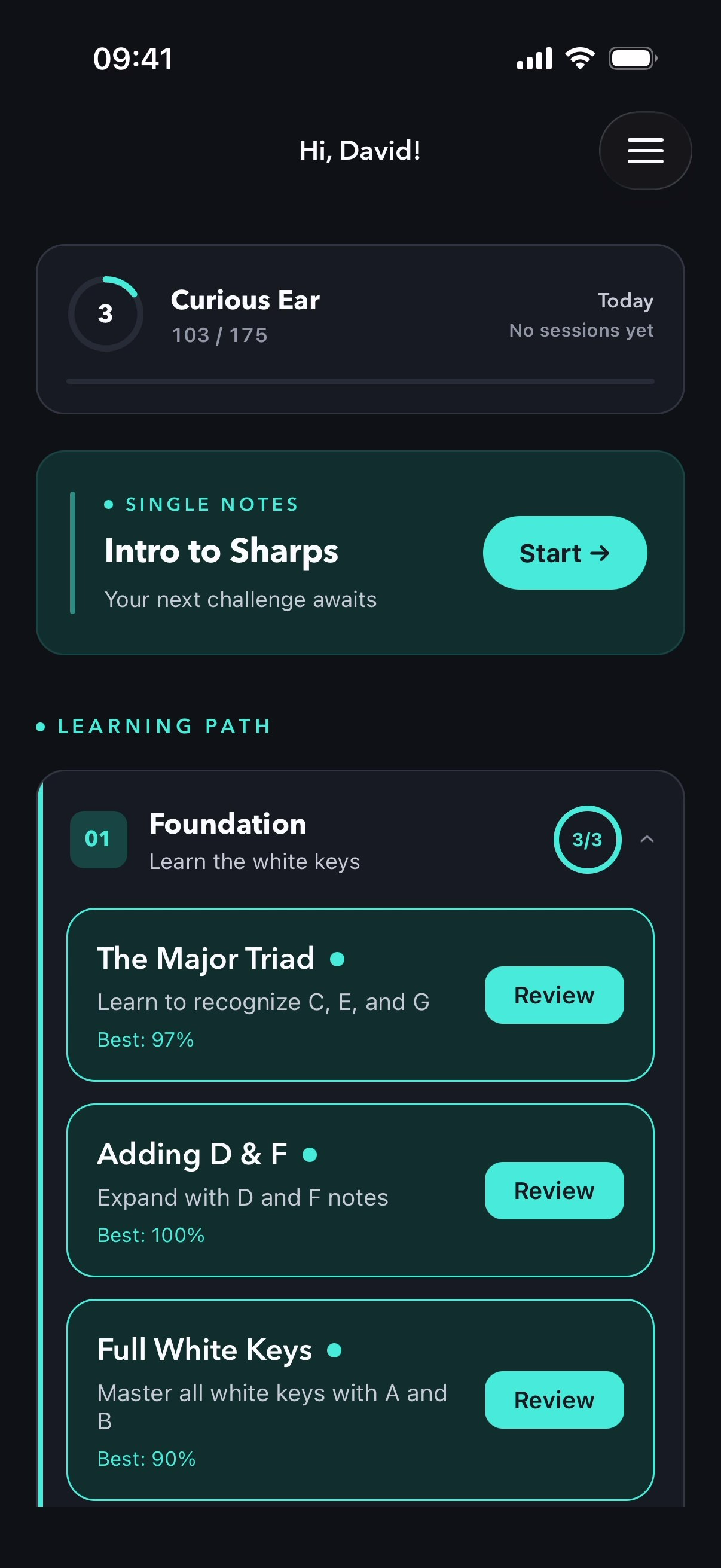
Designed around how
ears actually learn.
Most ear training apps teach relative pitch — intervals between notes. Absolute Ear trains something harder and more valuable: naming notes from sound alone, with no reference pitch.
Start small. Build mastery.
Begin with just C, E, and G — three tonally distinct anchors. Each new note unlocks only after you hit 80% accuracy across your last 20 attempts. No shortcuts.
Weak notes come back more often.
The algorithm tracks your accuracy per note and weights your practice toward the ones you struggle with most — so no note gets left behind.
Five ways to practice.
Single note recognition builds the foundation. Melodic dictation scales from 2-note sequences up to 5, and interval training progresses from a fixed tonic through multiple root notes to fully random roots. Then the app moves into harmony: hearing chords by function and recognizing the shape of common 4-chord loops by degree.
See exactly where you stand.
Per-note accuracy curves, chord and progression tracking, streaks, and mastery signals. Know which sounds you confuse most — and watch them tighten over time.
From pitch
into harmony.
Absolute Ear now continues past single notes and intervals into two full harmony chapters: Chords and Chord Progressions. The path stays anchored in C major, so your ear learns function first and labels second.
Hear where every chord lives relative to home.
Every harmony lesson starts from the same reference: I establishes home, then the ear learns lift, pull, darker color, and full resolution by scale degree.
Chords
Hear harmony in C major
Stay anchored in C major and learn what each chord feels like compared to home. You answer by scale degree, not by memorizing isolated chord names.
Progressions
Recognize chord patterns
Once the chords are familiar, order becomes the lesson. The same four chords can feel bright, wistful, lifted, or unresolved depending on where the loop begins and how it moves.
How it works.
Listen
A note plays from a real piano sample. Replay it as many times as you need. There is no time pressure.
Identify
Tap the note name you heard. Instant visual and haptic feedback confirms your answer.
Unlock
Hit 80% accuracy across 20 attempts to unlock the next module. Genuine mastery — not just repetition.
From three notes
to harmony.
The unlock order is deliberate — start with the most tonally distinct notes, then introduce each new pitch as your ear becomes more refined. Once the full chromatic set is in place, the path opens into chords and progressions.
Start training
your ears today.
Absolute Ear is free to download on iPhone and Android, with note recognition, melodic dictation, interval training, chords, and chord progressions in one learning path.
Absolute Ear is a passion project — solo-designed and built because I wanted an app that actually taught me to hear notes, not just guess them. It's made for musicians, students, and curious ears who want to develop something real: the ability to name any pitch from sound alone, without a reference, without shortcuts.